
Europe is moving from protecting what remains to actively restoring what has been lost. The EU Nature Restoration Regulation introduces legally binding targets, new monitoring obligations and a different framework for planning conservation investments. But will the funding follow, and how will we know whether restoration actually works?
Europe has spent decades establishing protected areas, safeguarding threatened species and regulating activities that damage natural habitats. Yet biodiversity continues to decline. According to the European Environment Agency’s 2025 assessment, 81% of habitats assessed under the Habitats Directive are in poor or bad conservation status.
The challenge is no longer simply to prevent further losses. Europe must reverse degradation, rebuild functioning ecosystems and demonstrate measurable ecological recovery. This is the fundamental change introduced by the EU Nature Restoration Regulation (EU) 2024/1991, which entered into force on 18 August 2024. Its implementation is now moving from European legislation to national plans, practical restoration measures and monitoring programmes.
For conservation practitioners, researchers, public authorities and environmental service providers, the implications extend well beyond new restoration projects. The Regulation will influence how conservation priorities are selected, how progress is measured, how ecological evidence is evaluated and, potentially, how conservation is financed over the next decade.
The central question will increasingly become not only what conservation actions have been implemented, but what ecological changes they have achieved.
1. A new legal framework: From conservation measures to measurable restoration targets
The Nature Restoration Regulation represents an important evolution in European conservation policy. While the Birds and Habitats Directives primarily establish obligations to protect species and habitats and maintain or restore their favourable conservation status, the new Regulation introduces additional, quantified and time-bound obligations to implement restoration measures across entire ecosystems.
Establishing a protected area, developing a management plan or implementing a conservation intervention does not necessarily mean that ecological conditions have improved. A protected grassland may continue to lose characteristic plant species. A forest may remain standing while its structural diversity declines. A restored river channel may look more natural without recovering its original aquatic communities.
The Regulation responds to this gap by linking restoration commitments to ecosystem condition, biodiversity indicators and long-term monitoring.
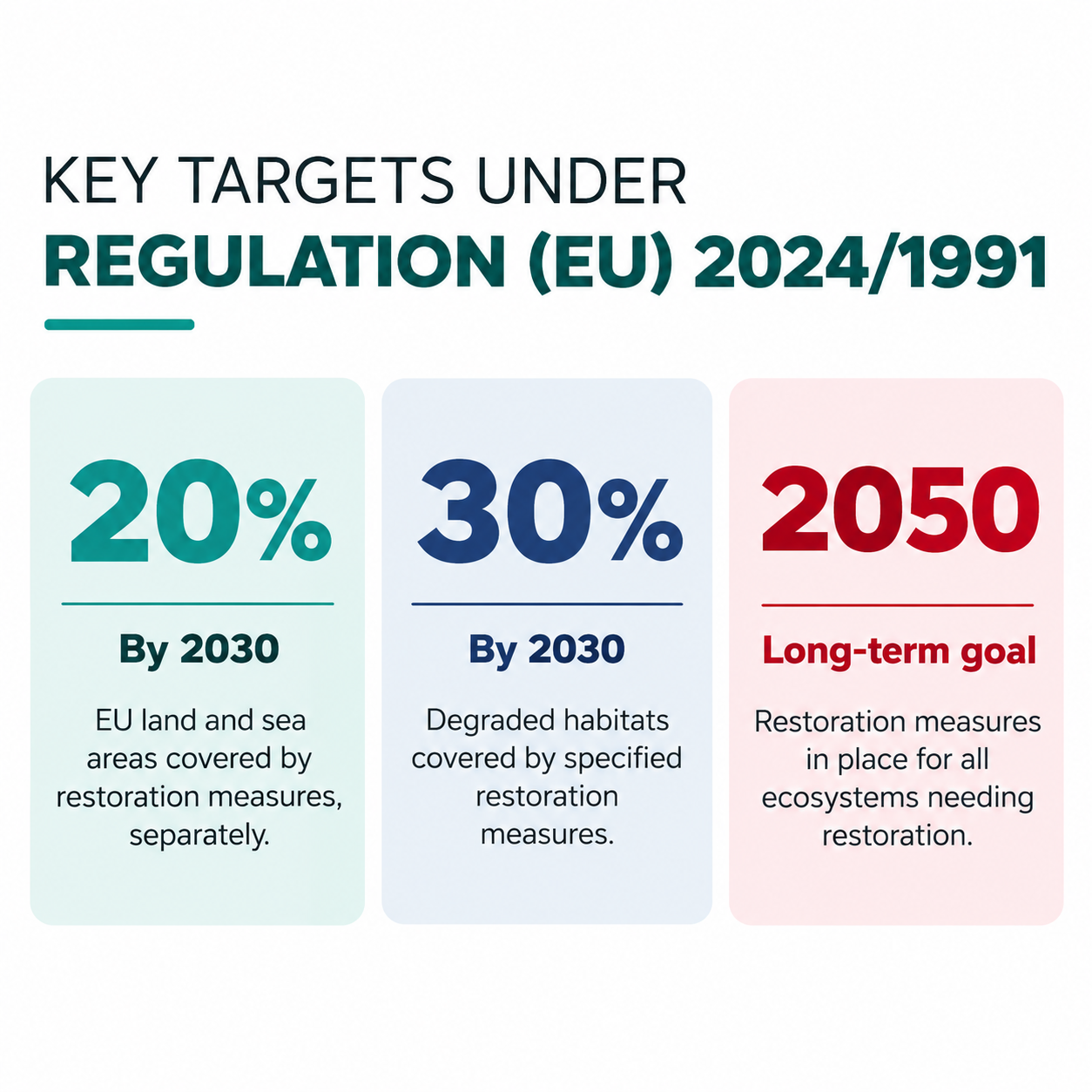
KEY TARGETS UNDER REGULATION (EU) 2024/1991
The overarching EU-wide objective is to put restoration measures in place covering at least 20% of the EU’s land areas and at least 20% of its sea areas by 2030, extending to all ecosystems in need of restoration by 2050.
More specific requirements apply to habitats covered by the Regulation. For terrestrial, coastal and freshwater habitat types listed in Annex I, Member States must put measures in place on at least 30% of the total area not in good condition by 2030. The requirements generally increase to 60% by 2040 and 90% by 2050 at the relevant habitat-group level, subject to specified exceptions. Marine habitat obligations follow a similar framework, with some differences between habitat groups.
An important distinction: these deadlines concern the implementation of restoration measures, not a guarantee that every habitat covered will have reached good ecological condition by the deadline. Ecological recovery may take decades, and the Regulation recognises this through its monitoring and improvement obligations.
Restoration beyond protected areas
The Regulation also expands the practical scope of conservation beyond traditional protected-area management.
It introduces requirements concerning agricultural and forest ecosystems, urban green infrastructure, rivers and floodplains, pollinators and drained peatlands.
For example, Member States must contribute to restoring at least 25,000 kilometres of rivers to free-flowing conditions across the EU by 2030. They must reverse the decline in pollinator populations by 2030 and subsequently achieve increasing trends. Agricultural ecosystems are assessed using indicators such as grassland butterflies, soil organic carbon, farmland birds and high-diversity landscape features.
Forest restoration involves common forest bird populations alongside indicators of forest biodiversity, including deadwood, tree-species diversity, native tree dominance and forest connectivity.
The Regulation also requires restoration measures for drained agricultural peatlands, with progressive targets towards 2050. Importantly, the Regulation does not itself oblige individual farmers or private landowners to rewet their land; rewetting remains voluntary for them unless national law provides otherwise.
For urban ecosystems, the initial objective is no net loss of urban green space and tree canopy cover at national level by the end of 2030, relative to 2024, subject to specified exclusions. Increasing trends are required thereafter.
Together, these provisions mean that biodiversity restoration is increasingly a responsibility shared among environmental authorities, agricultural and forest managers, municipalities, water-management agencies and marine sectors.
Conservation will have to become more closely integrated with decisions about how land, freshwater and marine resources are used.
2. National Restoration Plans will become central instruments of conservation planning
The Regulation is now entering a crucial implementation phase.
EU Member States were required to submit draft National Restoration Plans by 1 September 2026. The European Commission, supported by the European Environment Agency (EEA), is assessing these plans, with final national plans expected in 2027. The plans will identify restoration needs, describe proposed measures, establish implementation timelines and indicate the financial resources and monitoring arrangements required. They must cover the period to 2030 in detail while presenting a strategic perspective towards 2040 and 2050. This potentially changes how national conservation priorities are established.
Previously, restoration projects often emerged from specific funding calls, protected-area management priorities, research initiatives or local opportunities. While many delivered valuable results, they were not always components of a coordinated, long-term national restoration programme. National Restoration Plans offer a framework for connecting individual interventions with wider ecological objectives. For example, restoring a wetland may contribute simultaneously to improving a habitat’s condition, recovering threatened species, reducing downstream flood risks, improving water quality and supporting carbon storage. Similarly, restoring ecological connectivity across fragmented forests may require coordinated actions by forest managers, agricultural landowners, infrastructure authorities and wildlife-management agencies.
The most effective restoration measures will often be those that address several ecological objectives together, rather than treating habitats, species and ecosystem services as unrelated management concerns.
Better planning will require better baseline information
One of the first challenges is determining where restoration is needed most. Article 14 of the Regulation requires Member States to undertake preparatory monitoring and research, quantify restoration needs and consider scientific evidence when developing their plans. This requires answers to questions that are surprisingly difficult in practice.
What is the current condition of a particular habitat? Which characteristic species remain? How connected are populations? What ecological functions have been lost? Which pressures are responsible for degradation? And which interventions have the greatest potential to deliver lasting recovery? Existing monitoring systems can provide much of this information, but significant gaps remain, especially for less conspicuous organisms, poorly surveyed areas and ecological processes that are not routinely measured. These gaps will increasingly shape national restoration programmes and create demand for additional surveys, better integration of existing datasets and more efficient monitoring approaches.
3. Biodiversity monitoring is becoming a core component of restoration policy
Perhaps the most consequential change for conservation science is the transition from monitoring biodiversity status to also evaluating ecological recovery. Monitoring has traditionally supported several functions: detecting population trends, assessing conservation status, identifying threats and informing management decisions. All these remain essential.
The Nature Restoration Regulation adds a stronger requirement to evaluate whether implemented measures are delivering the intended results. This involves three related but distinct questions.
- First, what was done? This may involve recording the area of habitat restored, the number of barriers removed, modifications to forest management or the extent of peatland rewetting.
- Second, what changed? Here the relevant evidence concerns ecological outcomes: changes in habitat condition, species occupancy, population abundance, community composition or ecosystem functioning.
- Third, can the observed change reasonably be attributed to restoration? This requires separating the effects of interventions from natural variation, climatic changes and other factors acting simultaneously.
These distinctions are fundamental. Hectares under restoration are an implementation indicator, but they are not, on their own, evidence of ecological recovery.
Monitoring is now embedded in regulatory reporting
Article 20 establishes specific monitoring obligations covering habitat condition, species habitats, pollinators, agricultural and forest biodiversity indicators, and urban ecosystems. The monitoring frequencies differ according to the indicator. Several habitat and structural assessments must be conducted at least every six years, while indicators such as common farmland birds, common forest birds, grassland butterflies and pollinator populations require annual monitoring.
Under Article 21, Member States must begin reporting key implementation data by 30 June 2028, with subsequent reports generally every three years. More comprehensive progress and effectiveness reporting is due by 30 June 2031 and at least every six years thereafter. One particularly concrete development is the EU Pollinator Monitoring Scheme. The Commission adopted a standardised methodology in 2025, and Member States are expected to implement it by 16 December 2026. The scheme is intended to produce comparable annual data on pollinator abundance and diversity across the EU.
This illustrates the direction of European biodiversity monitoring: greater standardisation, stronger comparability between countries and more clearly defined relationships between collected data and policy objectives. It does not mean that every biodiversity-monitoring technique will be prescribed at EU level. The Regulation establishes indicators and reporting requirements, while many choices concerning sampling methods, survey design and complementary measurements remain with national authorities and research institutions.
From one-off surveys to monitoring systems
A single biodiversity survey can provide valuable information about which species occur in an area. It cannot normally establish whether restoration is successful. Demonstrating recovery requires comparable observations over time. Well-designed monitoring should therefore include a documented baseline, repeatable sampling protocols, appropriate reference or comparison sites, suitable temporal coverage and explicit treatment of statistical uncertainty.
Where feasible, before-after-control-impact designs can help distinguish restoration effects from changes that would have occurred anyway. At larger scales, hierarchical models, occupancy modelling and integrated population models can provide stronger inference from imperfect detection and heterogeneous datasets. The objective is not simply to collect more biodiversity data. It is to collect data that can answer clearly defined management questions.This will be particularly important when restoration outcomes develop slowly or when ecological responses differ substantially among sites.
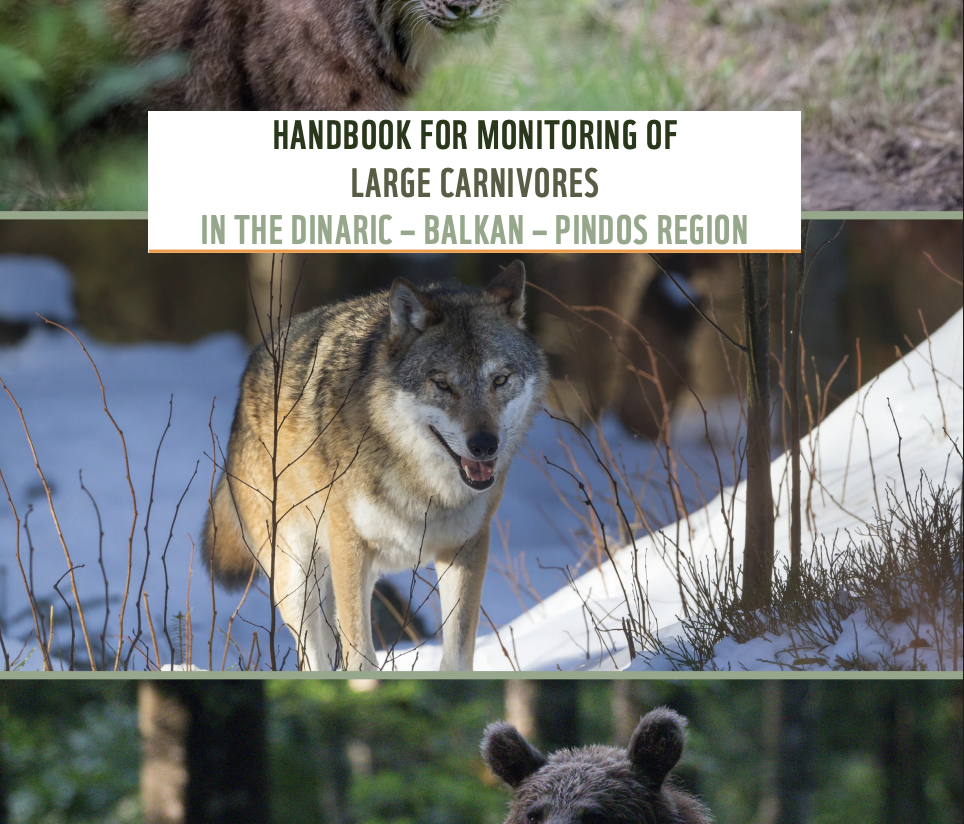
Expert Resource: Monitoring Large Carnivores Across Borders
Developed by DivjaLabs experts in collaboration with regional partners, the Handbook for Monitoring of Large Carnivores in the Dinaric–Balkan–Pindos Region provides practical guidance on standardised, scientifically robust and cost-effective monitoring of bears, wolves and lynx.
4. How molecular technologies can transform biodiversity monitoring
The expansion of restoration commitments creates a practical challenge: traditional biodiversity-monitoring methods are often labour-intensive, expensive and difficult to apply consistently across large areas. Conventional field surveys remain indispensable, particularly when assessing habitat structure, ecological processes and the abundance of organisms that can be reliably counted or observed. However, they do not always detect cryptic, rare, nocturnal or otherwise difficult-to-survey species. Identifying many invertebrates, microorganisms and other taxonomic groups also requires specialised expertise that is not available everywhere. Increasing monitoring demands without improving the efficiency of data collection may result in programmes that are expensive but still leave important biodiversity components poorly represented. This is where molecular technologies and modern biodiversity data analysis can make a substantial contribution.
Environmental DNA: Monitoring biodiversity at ecosystem scale
Environmental DNA analysis detects genetic material organisms release into their surroundings. DNA can be collected from water, soil, sediment and other environmental materials, allowing species to be detected without necessarily observing or capturing them.
In freshwater ecosystems, for example, eDNA can help document changes in fish, amphibian and other aquatic communities before and after restoration interventions. It can support the detection of species recolonising restored river sections, monitor invasive species and provide information on biodiversity in sites that are difficult to survey using conventional techniques.
In marine ecosystems, eDNA offers opportunities for repeated monitoring of species assemblages across large spatial areas, including areas where conventional sampling would be logistically demanding or disruptive.
The advantages are particularly relevant for restoration monitoring: standardised sampling can be repeated over time, and a single sample can yield information about multiple taxa. Nevertheless, eDNA should not be treated as a universal measure of ecological condition. DNA detection is influenced by environmental transport, persistence, sampling effort, laboratory methods and reference-database completeness. Detection does not necessarily establish local reproduction, population viability or habitat quality. Likewise, the quantity of DNA recovered is not a straightforward measure of organism abundance without appropriate calibration and ecological modelling. Its value is therefore greatest when applied to questions for which the relationship between molecular observations and ecological outcomes is scientifically defensible.
DNA metabarcoding: Looking beyond individual target species
One limitation of conventional monitoring is its frequent focus on selected indicator or protected species. While these species are important, restoration concerns entire biological communities. DNA metabarcoding can characterise multiple taxa from environmental samples, enabling investigations of community composition and changes in species assemblages. Depending on the sampling material and genetic markers used, it can provide information on plants, vertebrates, invertebrates, fungi and other organisms. It also allows researchers to investigate ecological interactions, such as dietary relationships, that may change as ecosystems recover. This can reveal developments that would be missed by monitoring a single flagship species.
For example, the return of a particular predator may indicate that a restored landscape is accessible to that species. But understanding the recovery of the wider ecological community, including its prey base and functional diversity, provides a more informative picture of ecosystem change. Metabarcoding datasets nevertheless require careful interpretation. Primer choice, amplification bias, sequencing depth and reference databases can influence detected diversity. Furthermore, species presence or community composition alone cannot establish whether the ecosystem has recovered its desired functions.
Population genetics: Recovery depends on more than species presence
Restoration frequently aims to improve habitat connectivity and enable the recovery of viable wildlife populations. However, the presence of a species does not necessarily indicate a healthy population. A population may remain genetically isolated, experience low reproductive success or suffer from declining genetic diversity despite apparently stable local occurrence. Population genetic methods can contribute information that conventional occurrence surveys cannot provide as readily. Depending on the available samples, genetic markers and analytical design, they can help identify individuals, estimate population size, reconstruct relationships, detect hybridisation and evaluate genetic connectivity between populations. Non-invasive genetic monitoring is particularly useful for elusive mammals and other species that are difficult to count through direct observation. In the context of nature restoration, such methods can help answer whether restored habitats are being recolonised, whether wildlife corridors facilitate actual movement and gene flow, and whether populations are becoming more resilient over time. These measurements are especially relevant when evaluating landscape-scale restoration. A corridor that appears structurally connected on a map may still fail to provide effective connectivity for particular species. Genetic data can help test whether apparent connectivity is reflected in biological processes.
Integrating molecular evidence with other monitoring methods
The most promising direction is not the replacement of traditional monitoring by molecular methods, but their integration. Remote sensing can document changes in habitat extent, vegetation cover and landscape structure. Field surveys can assess habitat quality, organism abundance and ecological processes. Molecular techniques can extend species detection and provide information about communities, individuals and populations. Together, these approaches can produce a more complete picture of ecological recovery. They also create opportunities for more efficient monitoring programmes. For example, remotely sensed environmental data can guide sampling-site selection, while molecular observations can help identify locations requiring more detailed field investigation.
5. Restoration monitoring must become more standardised, transparent and reproducible
If monitoring data are to support national restoration plans, European reporting and eventually financial decisions, their scientific quality becomes increasingly important. One of the persistent challenges in biodiversity monitoring is the fragmentation of data. Different organisations often use different sampling methods, spatial resolutions, taxonomic references, reporting periods and analytical approaches. Data may be scientifically sound within individual projects but difficult to combine into long-term or transboundary assessments.
At DivjaLabs, we are helping address this challenge by developing, implementing and promoting advanced genotyping-by-sequencing (GBS) methods that generate standardised, reproducible genetic data that can be reliably compared and exchanged across laboratories. By improving the interoperability of genetic monitoring datasets, these approaches support more consistent, long-term and transboundary biodiversity monitoring.
The Nature Restoration Regulation creates additional incentives to address this problem. The EEA and European Commission have already introduced common reporting structures and tools for preparing National Restoration Plans. These include standardised data models and the use of the EEA’s Reportnet infrastructure, which can reuse information submitted under other EU environmental legislation.
However, standardising reporting formats is only part of the solution. For monitoring programmes to produce comparable evidence, standardisation must begin at the sampling-design stage and extend through laboratory processing, quality assurance, statistical analysis and interpretation. For molecular monitoring, this means that field procedures, contamination controls, genetic markers, analytical pipelines and reference databases must be sufficiently documented and validated. Changes in protocols between monitoring rounds need to be evaluated because apparent biodiversity changes may otherwise reflect methodological differences. Sampling effort and detection probability must also be considered. A larger number of detected species does not necessarily demonstrate biodiversity recovery if sampling intensity or analytical sensitivity has increased. The same principle applies to traditional monitoring methods.
For long-term restoration programmes, transparent, reproducible and appropriately archived datasets are not merely desirable scientific practices. They are essential for credible assessment over decades.
6. Conservation funding after 2027: More investment opportunities, but also significant uncertainty
The Nature Restoration Regulation establishes long-term legal commitments, but it does not automatically provide the funding required to implement them. This is one of the central challenges for the coming decade. Restoration is expensive because it often requires more than a single intervention. Costs can include land management, changes in agricultural practices, hydrological restoration, habitat reconstruction, stakeholder engagement, monitoring and long-term maintenance. Some of these costs occur immediately, while ecological benefits may materialise gradually over many years.
At the same time, public budgets face competing pressures from defence, energy security, economic competitiveness, infrastructure and social expenditure. The European Commission’s economic assessments nevertheless indicate that investments in nature restoration can generate substantial benefits through ecosystem services, climate resilience, avoided damages and other outcomes. The economic returns differ considerably among ecosystem types and interventions and should not be interpreted as guaranteed financial returns to investors.
How large is the financing gap?
The scale of the challenge is substantial. In an October 2025 Council document, seven Member States referred to a draft Commission assessment estimating that implementation of the Nature Restoration Regulation would require approximately €11.8–13.1 billion annually until 2030. The same document reported estimated available funding of approximately €9.4 billion per year under the then-current financial arrangements, implying an annual gap of around €2.4–3.7 billion up to 2027. These figures were drawn from a draft assessment, rather than a final comprehensive cost accounting. They also did not fully include all costs associated with maintaining existing protected-area values and other related conservation needs. The broader biodiversity financing challenge is larger still. Conserving ecosystems, preventing degradation and transforming environmentally harmful practices require investments that extend beyond the restoration activities covered by this Regulation.
The current EU funding model: 2021–2027
Nature conservation has historically relied on a combination of EU funding instruments rather than one comprehensive conservation budget. The LIFE programme has been particularly important for supporting biodiversity, Natura 2000 management, restoration demonstrations and strategic nature projects. Other significant sources include the Common Agricultural Policy (CAP), cohesion-policy funds, the European Maritime, Fisheries and Aquaculture Fund, Horizon Europe, InvestEU and national or regional budgets. The 2021–2027 EU budget included a commitment to direct 7.5% of spending towards biodiversity in 2024, rising to 10% in 2026 and 2027.
However, the Commission’s June 2026 biodiversity budget monitoring indicated that, while the 2024 ambition had been met, the projected contributions for 2026 and 2027 were falling short of the initial 10% ambitions. This illustrates a persistent difficulty: environmental commitments do not always translate into sufficient dedicated financial resources.
7. The proposed 2028–2034 EU budget could fundamentally reshape conservation funding
The European Commission’s proposal for the next Multiannual Financial Framework (MFF), covering 2028–2034, introduces substantial structural changes. The proposal, presented in July and September 2025, provides for a total budget of almost €2 trillion in current prices. It includes a proposed benchmark directing 35% of EU expenditure towards climate and environmental objectives, potentially mobilising more than €700 billion over the seven-year period. Importantly, this is not a 35% biodiversity allocation. It encompasses a broad range of objectives, including climate mitigation and adaptation, water, pollution prevention, circular economy and biodiversity.
This distinction is crucial when assessing the future prospects for nature conservation. The new budget architecture could offer opportunities to integrate nature restoration into larger investment programmes. But it could also place biodiversity projects in competition with other climate and environmental priorities that have different economic characteristics and more easily quantified financial benefits.
A potentially significant change: The future of LIFE
Under the Commission’s 2028–2034 proposal, LIFE would no longer continue as a standalone EU funding programme. Instead, activities currently supported through LIFE would be integrated into broader instruments, principally the proposed European Competitiveness Fund and National and Regional Partnership Plans. This has prompted concerns because LIFE has provided a dedicated, internationally accessible funding mechanism for environmental projects, including those driven by conservation organisations, research institutions and partnerships operating across national borders.
A March 2026 study prepared for the European Parliament examined the proposed changes and highlighted the risks associated with replacing dedicated environmental funding with wider spending instruments. Seven Member States also raised concerns in the Environment Council in October 2025 about whether the future system would provide sufficiently predictable funding for biodiversity and nature restoration. The final outcome remains uncertain. As of October 2026, negotiations on the 2028–2034 budget are ongoing, and the proposed funding architecture has not been finally adopted. The Council’s latest negotiating framework was updated on 10 October 2026.
National Restoration Plans may become important in securing future funds
The Commission has explicitly proposed integrating national restoration priorities into the next budget’s environmental spending framework. Under the proposed National and Regional Partnership Plans, Member States would have greater responsibility for identifying investment priorities across agricultural, regional, cohesion and other policy areas. This could enable restoration measures to be financed as part of broader regional development, water resilience, agriculture and climate-adaptation programmes.
It also introduces a challenge. Where biodiversity objectives compete for resources within national investment plans, the effectiveness of National Restoration Plans may depend partly on whether restoration needs are translated into sufficiently detailed, credible and financed investment proposals.
For conservation organisations, this could mean that influencing national and regional programme design becomes increasingly important, alongside applying for individual EU project grants. For national authorities, there will be a need to develop restoration programmes with realistic costs, clear implementation responsibilities and demonstrable ecological benefits. The Commission has indicated that it will undertake further analysis of funding needs and available resources as national plans and budget negotiations advance.
What should conservation organisations expect?
Several developments are plausible, although their extent will depend on the final 2028–2034 budget and national implementation choices.
- Conservation funding may increasingly be integrated into wider programmes addressing water, agriculture, climate adaptation and regional resilience, rather than exclusively into conservation-specific grants.
- Projects demonstrating several public benefits—such as biodiversity recovery combined with flood-risk reduction or water-quality improvement—may be well positioned within such programmes.
- Long-term monitoring and verifiable outcomes may also become more important when justifying expenditure. This is consistent with the proposed budget’s stronger emphasis on performance and harmonised reporting, although individual funding rules have yet to be finalised.
- At the same time, projects focused on threatened species, ecological research or biodiversity recovery without immediately monetisable benefits may remain particularly dependent on dedicated public financing.
The critical issue is not only how much of the next EU budget is labelled environmentally relevant, but how much ultimately reaches conservation and restoration activities that deliver measurable ecological benefits.
8. Nature credits and private finance: A possible new market for measurable biodiversity recovery
Alongside changes in public funding, the EU is exploring ways to attract private investment into nature conservation and restoration. One of the most significant initiatives is the European Commission’s Roadmap towards Nature Credits, published in July 2025.
Nature credits are proposed as instruments that could reward verified actions delivering benefits for biodiversity and ecosystems. In principle, a land manager restoring a degraded wetland, improving ecological conditions on agricultural land or supporting biodiversity recovery could receive financial compensation linked to documented nature-positive outcomes. The concept has similarities with voluntary carbon markets, but biodiversity presents substantially greater challenges for standardisation.
Unlike carbon dioxide, which can be measured using a common mass unit, biodiversity is multidimensional and geographically specific. A gain in grassland species diversity cannot simply be equated with an improvement in marine habitat condition or forest connectivity. For nature credits to become credible financial instruments, they will require robust methods for establishing baselines, measuring ecological changes, verifying results and addressing additionality, permanence, displacement of environmental impacts and double counting. Importantly, nature credits do not necessarily have to function as offsets that compensate for biodiversity losses elsewhere. Financing positive contributions to nature, without claiming equivalence to environmental damage, is another potential model.
Where does the initiative stand in October 2026?
The EU is still developing and testing its approach. The 2025 roadmap provides for methodological work, expert consultation and pilot activities rather than an already operational EU-wide certification market. On 27 October 2026, during the UN Biodiversity Conference (COP17) in Yerevan, the European Commission launched the international Friends of Credits for Nature and Biodiversity initiative together with partner governments. The initiative aims to strengthen international cooperation on credible nature-credit approaches. This is a significant policy development, but it is not yet evidence that a mature, standardised and liquid nature-credit market will emerge.
There are legitimate concerns about the reliability of biodiversity metrics, the risks of greenwashing, the distribution of financial benefits and the possibility that voluntary private finance could be used to justify reductions in public conservation spending. A credible system will have to address these concerns before nature credits can be expected to finance restoration at scale.
Why biodiversity data will be essential for nature finance
The development of nature credits creates another potential role for biodiversity monitoring: independent measurement, reporting and verification. A project seeking financial compensation for ecological improvements must be able to demonstrate what conditions existed before an intervention, what changed afterwards and how confidently those changes can be attributed to the intervention.
This could increase demand for standardised biodiversity baselines, long-term monitoring and independent verification. Molecular biodiversity methods may contribute valuable evidence, particularly through measurements of community composition, the occurrence of target species and population-level genetic characteristics. However, no single molecular indicator can adequately represent biodiversity recovery in all ecosystem types.
Nature-credit methodologies will require carefully selected combinations of ecological indicators relevant to the restoration objective. The European Environment Agency has already identified better biodiversity data, spatial data infrastructure and impact metrics as essential components of improved financing for nature. This creates a potentially important connection between conservation science and environmental finance. The credibility of future nature markets will depend on the credibility of the biodiversity data used to support them.
9. What the next decade means for conservation organisations and environmental monitoring
The Nature Restoration Regulation establishes a legal direction that extends far beyond the 2030 deadline. Its practical impact will depend on how national authorities implement restoration plans, whether sufficient financing becomes available and how reliably ecological outcomes are assessed.
For conservation practitioners, several developments deserve particular attention.
Conservation planning will become more integrated
Species conservation, habitat management, climate adaptation, water management and sustainable land use will increasingly need to be addressed together. Projects that can contribute to several restoration objectives may offer important practical and funding advantages. However, integrating objectives must not come at the expense of species-specific needs or ecological integrity. Restoration measures should be selected according to ecological evidence, not simply the number of policy targets they can be associated with.
Monitoring will need to demonstrate change, not simply document activity
Monitoring programmes will increasingly have to provide information about whether ecosystems are recovering and whether management interventions are effective. This will require clearly defined objectives, reliable baselines, suitable indicators and long-term sampling strategies. Recent research also illustrates why methodological validation matters. A 2024 study of river restoration in the Netherlands found that DNA metabarcoding of collected macroinvertebrate samples could detect improvements associated with restoration, while water-based eDNA did not distinguish the relevant flow-related stress differences as effectively in that case. Similarly, a 2026 European Commission Joint Research Centre review found growing interest in DNA-based monitoring under the Water Framework Directive, while identifying reference-database gaps, difficulties in quantifying abundance and biomass, and methodological and regulatory uncertainty as barriers to wider operational implementation. These findings reinforce an essential principle: monitoring technologies must be evaluated according to the ecological questions they are intended to answer.
Long-term programmes will become more important than isolated projects
Ecological restoration commonly takes longer than conventional funding cycles. A three- or five-year project may successfully implement restoration measures without capturing the eventual recovery of habitats, communities or populations. This creates a strong rationale for monitoring systems that continue beyond individual projects, build on previous datasets and support adaptive management. It also creates an institutional challenge: funding mechanisms need to support not only restoration interventions, but also the continued collection and interpretation of biodiversity data.
The financing landscape may become more diverse, but less predictable
Public funding will remain essential, particularly for conservation activities that generate public benefits without producing direct private revenue. At the same time, conservation organisations may need to engage more closely with agricultural and regional development programmes, climate-adaptation funding, financial institutions and emerging nature-finance initiatives. The final structure of the 2028–2034 EU budget will strongly influence these opportunities. Organisations that combine ecological expertise with the ability to design measurable, financially realistic and technically robust restoration programmes will be well placed to participate in this changing landscape.
10. From biodiversity data to better conservation decisions
The Nature Restoration Regulation creates an opportunity to improve not only the extent of conservation activity in Europe, but also its effectiveness. For decades, conservation practitioners have faced a recurring challenge: they have been expected to protect biodiversity and demonstrate results, often without the resources or monitoring systems needed to measure ecological changes adequately. New legal obligations will not automatically solve that problem. But they create a stronger incentive to develop monitoring approaches that provide useful, reliable and comparable information.
At DivjaLabs, we see particular opportunities in combining non-invasive genetic monitoring, environmental DNA, DNA metabarcoding and population-genetic analysis with established ecological survey methods. Such approaches can support biodiversity assessments, help identify changes in species communities, evaluate wildlife-population connectivity and provide additional evidence about restoration outcomes. Our emphasis is on selecting methods that match the ecological question, applying appropriate quality controls and translating complex genetic data into information that conservation practitioners can use. As restoration obligations expand, this combination of scientific rigour, efficient monitoring and practical interpretation will become increasingly valuable.
Conclusion: Europe’s restoration ambitions will be measured by ecological results
- The EU Nature Restoration Regulation marks a substantial shift in European conservation policy.
- It strengthens the focus on ecological recovery, expands restoration obligations beyond protected areas and creates a long-term framework for monitoring and reporting results.
- Its consequences for biodiversity monitoring are likely to be particularly significant. Reliable baselines, standardised protocols, integrated monitoring technologies and scientifically defensible assessments will become increasingly important.
- The future funding picture is more uncertain. The proposed 2028–2034 EU budget would significantly reorganise environmental finance, while emerging mechanisms such as nature credits may introduce additional opportunities for private investment. Neither development guarantees sufficient funding for biodiversity restoration.
- The decisive challenge for the next decade will be connecting restoration objectives with adequate financing, effective interventions and evidence capable of demonstrating ecological recovery.
- Europe is moving towards a conservation system in which success is increasingly judged not only by the measures implemented, but by whether nature actually recovers.
Key sources and further reading
The article is based primarily on EU legislation, European Commission and EEA publications, and research available as of 28 October 2026.
-
Regulation (EU) 2024/1991 on nature restoration — Binding targets, monitoring obligations, national planning and reporting.
-
European Commission: National Restoration Plans (2026) — Implementation status and national financing arrangements.
-
Nature Restoration Regulation Implementation Portal — Monitoring methodologies, planning guidance and funding information.
-
EEA: State of Europe’s Biodiversity (2025) — The evidence underpinning Europe’s restoration challenge.
-
European Commission: Proposed EU Budget 2028–2034 — Proposed future funding structure.
-
European Parliament: Impacts of the 2028–2034 MFF on Climate and Environment (2026) — Independent analysis of funding risks and proposed changes.
-
European Commission: Roadmap towards Nature Credits (2025) — Emerging biodiversity financing approaches.
-
JRC: Exploring DNA-Based Approaches for Monitoring and Classification in the Water Framework Directive (2026) — Opportunities and limitations of molecular monitoring.