
Info point
Focusing on application of cutting edge molecular and computational tools to real world problems.



March 18, 2026
Science-driven coexistence: Results from the 2023 Slovenian brown bear genetic monitoring
The 2023 genetic monitoring of brown bears in Slovenia, utilizing extensive non-invasive DNA sampling analysed by DivjaLabs, estimated a highly precise minimum autumn population of 737 individuals. Although the population has grown linearly over the past two decades and is slowly expanding its spatial range, current science-based management strategies aim to stabilize the numbers to ensure long-term human-bear coexistence.
.
March 16, 2026
Expanding or staying distinct? New genetic insights into Europe’s golden jackals
A recent genetic study co-authored by DivjaLabs researchers investigated the population dynamics of European golden jackals, focusing on the contact zone between the rapidly expanding Pannonian population and the historically isolated Dalmatian population. The analysis of new genetic samples from multiple countries revealed that while Pannonian jackals are driving the species' broader European expansion, the Dalmatian population remains largely distinct and restricted, showing only sporadic evidence of long-distance gene flow extending as far as eastern Italy..
Read moreDecember 30, 2025
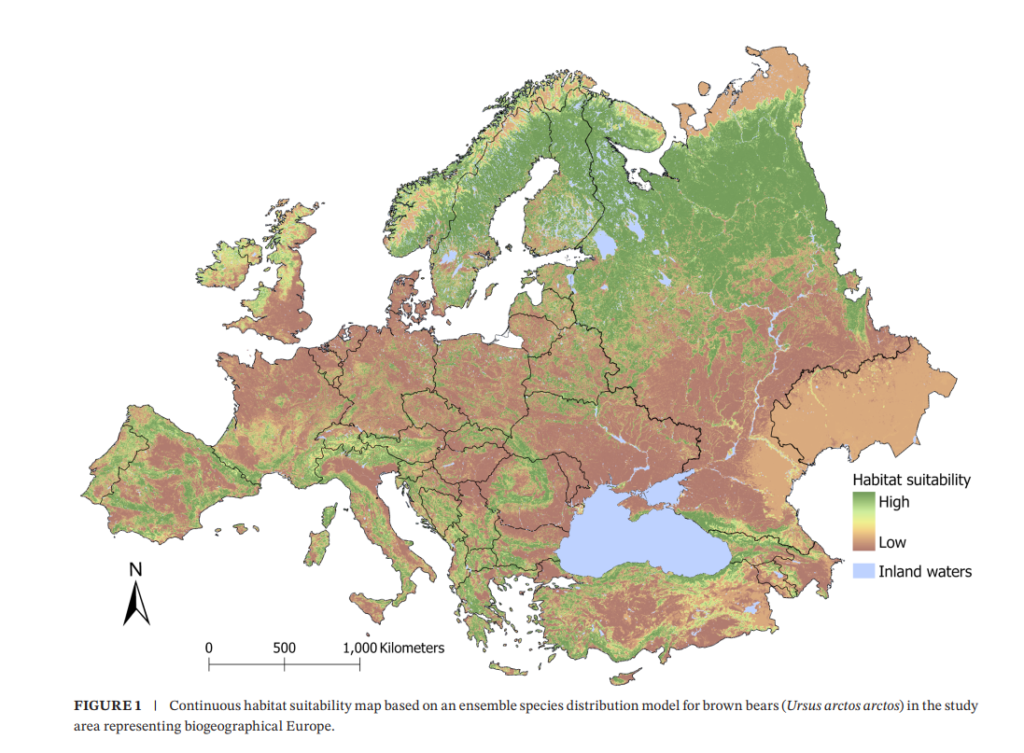
Plenty of habitat but limited connectivity for brown bears in Europe
A newly published study in Diversity and Distributions paints a nuanced picture of the future of brown bears in Europe: while large areas of the continent still offer suitable habitat, human-dominated landscapes increasingly restrict the connections that bears need to move, disperse, and maintain healthy populations..
Read moreNovember 13, 2025
Rethinking Hybrids: A Call for Nuance in Biodiversity Conservation
A new global study co-authored by DivjaLabs scientist Dr. Astrid Vik Stronen challenges long-held views on hybrids in biodiversity management. Published in Conservation Letters, the paper calls for science-based, case-by-case approaches that recognize that although hybrids often represent to native species, they might, at time be potential contributors to resilience and adaptation..
Read moreOctober 28, 2025
Mapping the genetic story of British Columbia’s grizzly bears
DivjaLabs co-founder Astrid Vik Stronen coauthors new genomic study revealing adaptation across coastal and interior landscapes..
Read moreJune 5, 2025
DivjaLabs at Wolves Across Borders 2025: Bridging science, conservation, and innovation
This week, DivjaLabs is proud to participate in Wolves Across Borders 2025, held in the picturesque town of Lunteren, The Netherlands. As a Silver Sponsor, our involvement underscores our commitment to advancing conservation through state-of-the-art molecular and computational tools. Beyond supporting the event with a stand, our team is actively contributing scientific insights that support transboundary collaboration and informed wolf management across Europe..
Read moreJune 4, 2025
New Research: Trophic Interactions Hold the Key to Brown Bear Conservation in a Changing Europe
We’re excited to announce that DivjaLabs researchers Marta De Barba and Tomaž Skrbinšek are among the co-authors of a study just published in Global Change Biology. The research, titled “Trophic Interactions Are Key to Understanding the Effects of Global Change on the Distribution and Functional Role of the Brown Bear,” sheds new light on how climate and land-use change are reshaping the ecological dynamics of Europe’s largest terrestrial predator—the brown bear (Ursus arctos)..
Read moreApril 22, 2025
How non-invasive genetics and collaboration are shaping the future of wolf conservation in the Romanian Carpathians
The Carpathian Mountains are home to one of Europe’s last strongholds for large carnivores, and a new study shines a spotlight on just how important—and complex—this landscape is for wolves (Canis lupus).
In a collaborative effort, scientists from Fundatia Conservation Carpathia and DivjaLabs, along with academic partners from Romania, Slovenia, and Hungary, have published a study in Ecology and Evolution that delivers one of the most comprehensive noninvasive assessments of wolf population size and composition ever conducted in the region..
January 28, 2025
Exploring genomic rewilding: DivjaLabs’ co-founder contributes to important research
At DivjaLabs, we are committed to advancing scientific understanding of biodiversity and genetics, and we are thrilled to celebrate the recent publication co-authored by one of our lead scientists and co-founder, Astrid Vik Stronen. This important study, titled "Genomic Rewilding of Domestic Animals: The Role of Hybridization and Selection in Wolfdog Breeds," was published in the prestigious journal Genes in January 2025..
Read more